Showing posts with label population of the world. Show all posts

Monday, July 4, 2011

Some trends for the decade ahead in Australia


Jack Dikian
July 2011

  1. There are now signs that the growth of social networks may be flattening out and people beginning to look for internet based tools and practical applications.

  2. The combined effects of the Global Financial Crisis and environmental sustainability may bring about a slowdown to rampant materialism.

  3. Flexibility, job variety and work-life balance will remain part of employment, a return to training, skill development, and longer job tenure and stability.

  4. This decade will see Australia's population hit 27 million.


Source: McCrindle Research & ABS– analysis and graphics by J. Dikian


Wednesday, June 29, 2011

Life expectancy in Australia


Jack Dikian
June 2011

22,637,535

Is the resident population of Australia is projected as of June 29, 2011


Life expectancy at birth is one of the most widely used and internationally recognised indicators of population health Australian Bureau of Statistics. High life expectancy at birth indicates low levels of infant mortality, a safe environment in which to live, a good health care system, sufficient food, and the adoption of preventative health measures.


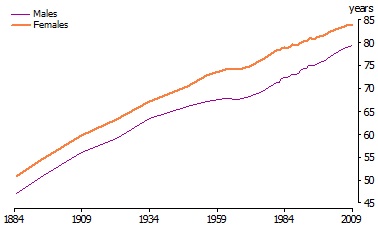
This is a brief look at the significant increase in life expectancy in Australia over the past 125 years, some of the reasons for the increase. The life expectancy for Australians has increased by over 30 years since the late 1800s. During 1881-1890, the average life expectancy of a newborn boy was around 47 years and that of a newborn girl almost 50 years. By 2007-2009, average life expectancy had risen to approximately 80 years for newborn boys and 84 years for newborn girls.


10 percent of all deaths each year until the early 1930s was associated with infectious and parasitic diseases. Improvements in living conditions in the early 20th century led to overall lower death rates and longer life expectancy at all ages. At the same time, degenerative diseases such as heart disease, stroke and cancer replaced infectious and parasitic diseases as the main cause of death of older people in the 20th century.


The past 20 years have seen further increases in life expectancy. These increases have been partly due to lower infant mortality, fewer young people dying in motor vehicle accidents, and fewer older men dying from heart disease. The reduction in deaths from heart disease has been linked to medical advances and behavioural changes such as improvements in diet and less smoking.


Monday, January 31, 2011

Sheer Size Of Social Networks


Jack Dikian
January 2011

I fired up the laptop wanting to write a book review of Ben Mezrich’s "The Accidental Billionaires," The Founding of Facebook, A Tale of Sex, Money, and Betrayal”, the story that inspired The Social Network Movie - and slowly started wondering about the sheer enormity of these networks. Many with millions and millions of users – all connected by friendship, kinship, common interest, financial exchange, likes, dislikes, and on and on.

I thought instead of the book review, I’d have a quick look at the size of the more popular social network sites by the approximate number of registered users. I crunched these numbers so to compare the size of the ten most popular networks with the remaining 120 networks by size of registered users.

As we can see below the top ten sites account for some 60% (approx 1.7 Billion) of [all] registered users across 130 sites totaling almost 3 Billion users. Facebook alone has almost 0,5 Billion users.

Interestingly, The population of the world is currently about 6,896,900,000 and it is estimated that the percentage of the population in the age group of 16-64 is roughly about 64% or 4.4Billion. So almost 70% of people who [could] be using a social network are – of course this isn’t quite right as many people subscribe to a number of social network sites.

Top 10 social networks by number of registered users


Approximate Number of Registered Users


Facebook

500,000,001

Qzone

200,000,000

Twitter

175,000,000

Habbo

162,000,000

Windows Live Spaces

120,000,000

Bebo

117,000,000

Vkontakte

110,578,500

Myspace

100,000,000

Orkut

100,000,000

Tagged

100,000,000

Top ten social network sites by number of registered users

1,684,578,501

Other 120 social network sites by number of registered users

1,300,370,463

Total of top 130 social network sites by registered users


2,984,948,964