Sunday, July 10, 2011

Cost of Carbon and Need To Know


Jack Dikian
July 2011

AUSTRALIA will have a carbon tax for three to five years before a full emissions trading scheme is introduced, under a blueprint for dealing with climate change agreed by a multi-party parliamentary committee.

Julia Gillard has unveiled the key principles of the government's climate policy today, saying a fixed price would be placed on carbon pollution from July 1 2012. She announced a carbon price of $23 per tonne to begin with rising at 2.5 per cent a year.

Related economics, politics and the myriad of expert opinion on both sides of the climate debate, we have heard and will continue to.

I want to make a few points, and perhaps, throw in a little analysis – the type one does on the back of a postcard.

  • Counter intuitive as it is, mid to long term climate change is actually easier to predict than weather conditions for the short term. Chaos Theory doesn’t help.
  • Mankind does contribute to atmospheric Carbon (mostly in the form of Carbon Dioxide CO2). In fact, since the industrial revolution, the concentration of CO2 in the atmosphere has increased (approx.) from 280 ppm, to today’s concentration levels of about 380ppm. This is a very small increase, but an increase nevertheless. Remember, air is mostly Nitrogen and Oxygen.
  • Whether an increase in CO2 levels associated with mankind is capable of generating marked impact on climate is still difficult to call.
  • If Australians wish to reduce CO2 leaking into the atmosphere (note I’m not saying this will impact climate) then a price on Carbon WILL, overtime, reduce our contribution of atmospheric CO2 as correctly stated by our PM. Take for example two companies producing the same product. The company that is leaking more CO2 will have a greater production cost (because they will have to pay for carbon emission) and thus, its products will ultimately cost more than the company leaking less CO2. It is rightly assumed we (consumers) will purchase the cheaper of the two products.

Table 1 below presents 17 countries ranked by CO2 emissions and relative percentage of global total. Australia is sitting at 17th place behind Indonesia.

  • It should be noted that our per capita contribution is extremely high. An average Australian produces approximately 5 tonnes of carbon emissions per year.
  • Carbon and Carbon dioxide are often conflated when talking about greenhouse gas emissions. The carbon that is present in the fossil fuels combines with oxygen during combustion to produce CO2.
  • How much is a tonne of Carbon? 1 tonne of CO2 (in gaseous state) is composed of Carbon and Oxygen. Carbon’s atomic mass is 12 and Oxygen’s is 16 so Carbon is about one third of the mass of CO2. One tonne of CO2
gives us 556.2m³ or about 4000 black balloons.

Table 1


China

23.33%

United States

18.11%

European Union

14.04%

India

5.78%

Russia

5.67%

Japan

4.01%

Germany

2.61%

Canada

1.80%

Iran

1.79%

United Kingdom

1.73%

South Korea

1.69%

Mexico

1.58%

Italy

1.48%

South Africa

1.45%

Saudi Arabia

1.44%

Indonesia

1.35%

Australia

1.32%

Friday, July 8, 2011

Australian Households Technology Usage Trends


Jack Dikian
July 2011


Children growing up in the 21st century are technology savvy and interestingly and have never known life without access to computers and the internet. Much has been said of the internet as a source of information, knowledge, entertainment and social communication.

Looking at technology access for Australian households with children – the graph compares trends in technology access in households with children with households without children. This is an important given homes are an important place for children to access computers, the internet and [some of the associated] benefits.

Source: ABS


Thursday, July 7, 2011

The Smell Of Space


Jack Dikian
July 2011

We know that virtual particles permeate space (a vacuum) and according to QED every particle spends some time as a combination of other particles in all possible ways popping in and out of existence.

Now we also know that space has an odour. Astronauts coming back from space-walks. One astronaut said about the scent “the best description I can come up with is metallic; a rather pleasant sweet metallic sensation”.

Monday, July 4, 2011

Some trends for the decade ahead in Australia


Jack Dikian
July 2011

  1. There are now signs that the growth of social networks may be flattening out and people beginning to look for internet based tools and practical applications.

  2. The combined effects of the Global Financial Crisis and environmental sustainability may bring about a slowdown to rampant materialism.

  3. Flexibility, job variety and work-life balance will remain part of employment, a return to training, skill development, and longer job tenure and stability.

  4. This decade will see Australia's population hit 27 million.


Source: McCrindle Research & ABS– analysis and graphics by J. Dikian


Wednesday, June 29, 2011

Life expectancy in Australia


Jack Dikian
June 2011

22,637,535

Is the resident population of Australia is projected as of June 29, 2011


Life expectancy at birth is one of the most widely used and internationally recognised indicators of population health Australian Bureau of Statistics. High life expectancy at birth indicates low levels of infant mortality, a safe environment in which to live, a good health care system, sufficient food, and the adoption of preventative health measures.


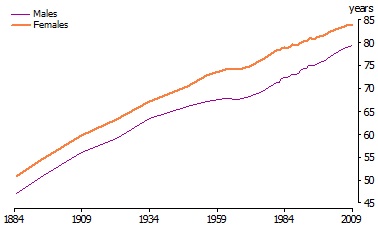
This is a brief look at the significant increase in life expectancy in Australia over the past 125 years, some of the reasons for the increase. The life expectancy for Australians has increased by over 30 years since the late 1800s. During 1881-1890, the average life expectancy of a newborn boy was around 47 years and that of a newborn girl almost 50 years. By 2007-2009, average life expectancy had risen to approximately 80 years for newborn boys and 84 years for newborn girls.


10 percent of all deaths each year until the early 1930s was associated with infectious and parasitic diseases. Improvements in living conditions in the early 20th century led to overall lower death rates and longer life expectancy at all ages. At the same time, degenerative diseases such as heart disease, stroke and cancer replaced infectious and parasitic diseases as the main cause of death of older people in the 20th century.


The past 20 years have seen further increases in life expectancy. These increases have been partly due to lower infant mortality, fewer young people dying in motor vehicle accidents, and fewer older men dying from heart disease. The reduction in deaths from heart disease has been linked to medical advances and behavioural changes such as improvements in diet and less smoking.


Sunday, June 26, 2011

Is it possible to think about nothing?


Jack Dikian
June 2011

René Descartes is often credited with being the Father of Modern Philosophy. He broke away from the Scholastic philosophy of the time (16th century) believing their method was prone to doubt given the reliance on sensation as the source for all knowledge.

Descartes’ strategy was to consider false any belief that falls prey to even the slightest doubt. Descartes sets out to find something that lies beyond all doubt. He eventually discovers the conjecture “I exist” is impossible to doubt and is, therefore, absolutely certain.

Descartes is perhaps best known therefore for the philosophical statement "Cogito ergo sum" or I think, therefore I am. Using this logic, he went on to demonstrate God’s existence and that God cannot be a deceiver… I had to wait until I was at university to do Descartes, Spinoza, and Leibniz.

Primary school kids in Europe have been taught Philosophy for the last 50 years, and now, in the last few years it is being taught in some NSW schools. This includes ethics, logic, political philosophy, metaphysics and epistemology.

The Philosophy in Schools Association of New South Wales is a non-profit organization dedicated to promoting and supporting philosophy in schools in New South Wales.

According to their website, their approach to teaching philosophy in schools encourages the development of an inquiring classroom community. Such a learning community encourages the development of:

• an inquiring outlook

• the ability to articulate problems and issues

• imaginative and adventurous thinking

• the habit of exploring alternative possibilities and different points of view

• the capacity to critically examine issues and ideas good reasoning and independent judgment

Here are a few head scratching questions to ponder over:-

1. Does the beach belong to you?
2. Is an apple alive?
3. If no one sees something, can it still be beautiful?
4. Show we ever tell a lie?
5. Does everything happen for a reason?
6. Where do you go when you’re dead?
7. Is it possible to think about nothing?
8. What do we call the future when it is in the future?

Wednesday, June 22, 2011

The Making of the Atomic Bomb


Jack Dikian
June 2011

I first read The Making of the Atomic Bomb, by Richard Rhodes in 1997, ten years after its first publication. Reading the account of the development of the most destructive war weapon ever to be created in 1997, I was already aware that Rhodes had received the 1987 National Book Award, the 1988 Pulitzer Prize for General Nonfiction, and the 1988 National Book Critics Circle Award for General Nonfiction. So at the time, I knew I was about to take an 800-page journey through the science, the scientists, the historical and political need for such a weapon, and an insight into the thoughts, values and difficult moral and ethical dilemmas highly recognized scientists had to face should their work was successful.

Of course we know from history the first test atomic bomb, called Trinity, was exploded in the New Mexico desert on July 16, 1945. On August 6, an atomic bomb was dropped on the Japanese city of Hiroshima. 3 days later, another atomic bomb was dropped on the Japanese city of Nagasaki. On August 14, 1945, Japan agreed to an unconditional surrender to the Allies, thus ending World War II.

Reading this book again recently, I thoroughly enjoyed Rhodes’ ability to capture the twists and turns of an era in our not-so-distant past that propelled government, science and industry to muster the enormous resources of a nation in order to weaponise the theoretical possibilities of nuclear reactions.

For me, one of the standouts of this book is Rhodes’ detailed account of the countless scientists whose work eventually culminated in the making of the first atomic bomb. Rhodes provides us with the lives and work of individual scientists and weaves a thread through their contributions to convert what was initially pure scientific research into the creation of a the atom bomb.

At times, the science gets a little hairy but the reader is more than rewarded by its rich drama, suspense and surprise. For example, there was even a third ''gadget'' being readied to be dropped on Japan, even as Hiroshima and Nagasaki smoldered.

The book's bibliography is some 600 entries long, and Rhodes has fleshed out this archive by interviewing the living principals and by traveling to the sites and shrines of the atomic era.